
Pathways to Political Science Summer Research Program hosts fourth cohort of interns
Pathways@GDL is planning for a fifth cohort in the summer of 2027
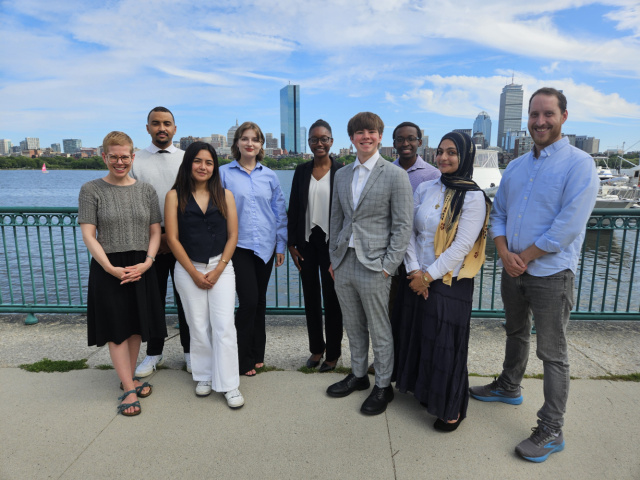
2026 Pathways@GDL Program participants:
Left to right
Prof. Ariel White, Ezra Mendel, Andrea Asmat, Natalie Novoseltseva, Zoë Williams, Ember Jones, Nnamdi Mbajekwe, Aamina Al-Yahia, and Prof. Noah Nathan.
Photo credit: Kate Searle
This summer, the Political Science Department and the Global Diversity Lab (GDL) hosted its fourth cohort of Pathways to Political Science Summer Research interns. Pathways@GDL is sponsored by the Political Science Department and the Center for International Studies (CIS) in partnership with the MIT Summer Research Program (MSRP). Professors Noah Nathan and Ariel White led the Pathways@GDL program.
Pathways@GDL is aimed at broadening the pipeline into US political science PhD programs. A masters student from University of Witwatersrand in South Africa joined undergraduates from universities in Florida, Indiana, New York, North Carolina, Virginia, and Washington DC, mixing research assistant work and their own independent research projects, professionalizing their presentation of research, and exchanging information with each other and Department of Political Science faculty.
Those interested in receiving information about becoming a member of the summer of 2027 cohort should email Tina Shewarega at tinashew@mit.edu.
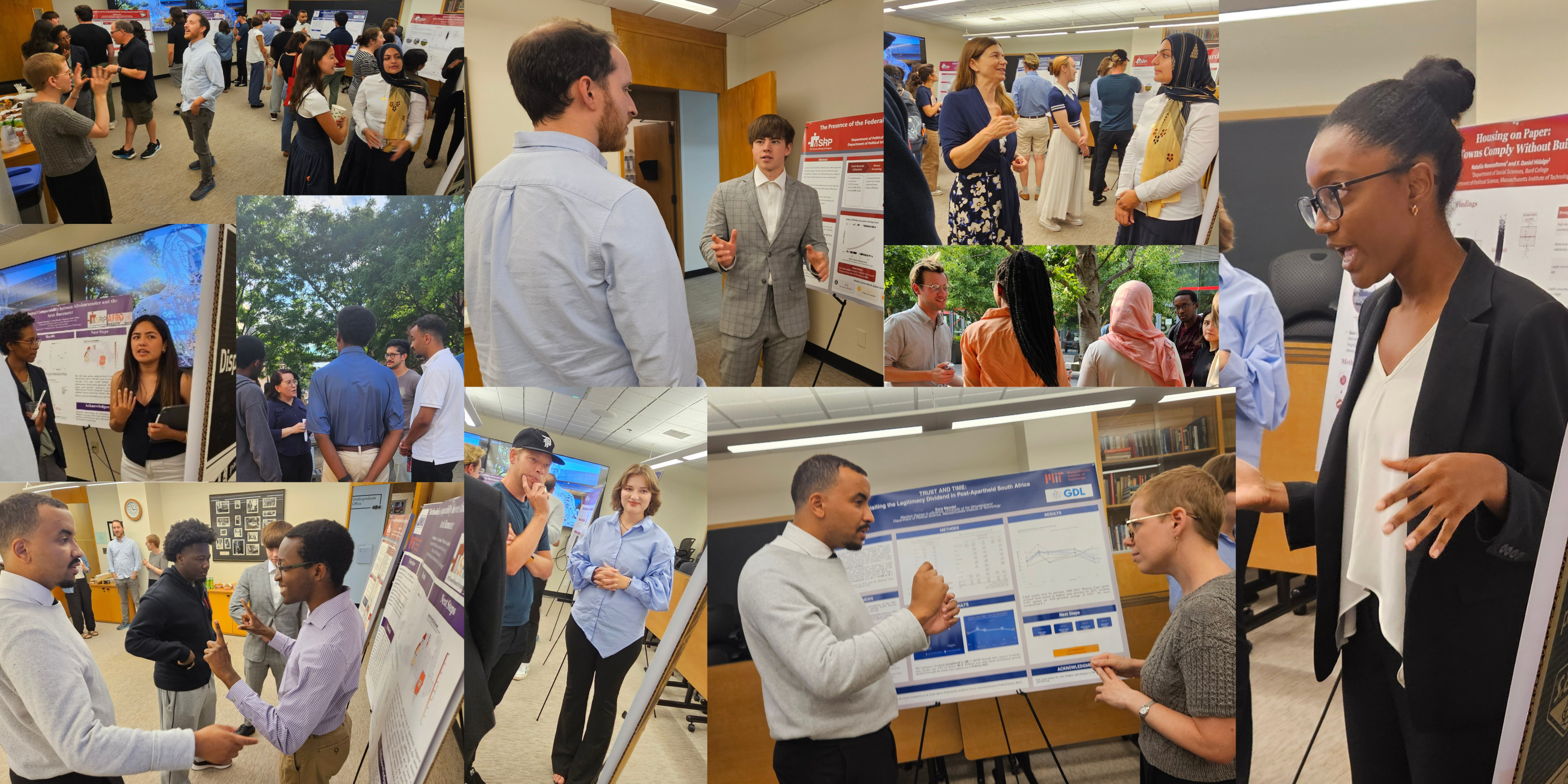
The Department of Political Science hosted a lively poster session on August 5. Clockwise from the upper left:
Prof. Noah Nathan (center) admires the assembled crowd in the Millikan Room.
Ember Jones of North Carolina Central University explains his poster “The Presence of the Federalist Society Among Supreme Court Clerks” to Professor Noah Nathan. He served as Research Assistant for Professor Adam Berinsky, utilizing trace data to examine political affiliation and trust of AI labels. He is also developing an independent research project investigating the public affiliation former Supreme Court clerks have with the Federalist Society.
Professor Andrea Campbell asks Aamina Al-Yahia of the University of Florida about her poster “Trust, Transition and Participation: Civic Engagement Among Syrian University Students in Post-Assad Syria.” Aamina served as a Research Assistant to Professor Richard Nielsen on the effect of belief in Divine Intervention on warfare practices and did independent research under Professor Mai Hassan on Syrian-American attitudes toward return during post-Assad reconstruction.
Zoë Williams of Howard University makes a point about her poster "The Impact of Civil Service Reform on Police Activity Across Cities with Different Ethnic Compositions.” Zoë conducted independent research under Professor Ariel White on how the adoption of civil service reforms has affected police activity, conditional on a city’s ethnic makeup. In her research assistantship for Professor In Song Kim, she explored how pharmaceutical products have been affected by Section 232 tariffs.
In response to a question from Professor Ariel White, Ezra Mendel of the University of Witwatersrand in South Africa hones in on one of the finer points of his poster, “Trust and Time: Revisiting the Legitimacy Dividend in Post-Apartheid South Africa.” He served as a Research Assistant for Afrobarometer, comparing the Afrobarometer and Arab Barometer surveys across countries where the two overlap. His thesis examines transitional justice, state capture, and the fragility of institutional trust in post-TRC South Africa, drawing on the South African Reconciliation Barometer to trace how public trust in institutions has shifted across the post-apartheid era.
Natalie Novoseltseva of Bard College discusses her poster, "Housing on Paper: How Towns Comply Without Building” with Professor Richard Nielsen. She served as research assistant to Professor Daniel Hidalgo on paper compliance in housing policy—specifically land-zoning practices for multifamily housing development in Massachusetts—modeling parcel-level financial feasibility to assess development outcomes.
Nnamdi Mbajekwe of James Madison University discusses his poster "Methodological Comparability Between the Afrobarometer and Arab Barometer” with Ezra Mendel. He served as Research Assistant for Afrobarometer on the project comparing the Afrobarometer and Arab Barometer surveys, analyzing countries that overlap in both to see whether the organizations can further standardize their methodologies where discrepancies exist.
Andrea Asmat of Purdue University answers Professor Mai Hassan's questions about her poster “Survey Recruitment through Social Media.” Andrea conducted research with Professor Daniel Hidalgo on survey methodology and political behavior, including projects that use digital tools such as WhatsApp-based surveys to enable more precise micro targeting in Peru and Brazil.
Beyond the formal poster session, interns enjoyed lively discussions with PhD students and professors in the Department of Political Science throughout the summer. In the center left photo, PhD student Carla Garcia makes a point to Ezra Mendel at a reception in June and in the center right photo, PhD student Clemente Sanchez talks with Zoë Williams and Aamina Al-Yahia talks with Nnamdi Mbajekwe at a reception in July.