
First year students meet to discuss all things politics
New advising seminar exposes students to the field of political science.
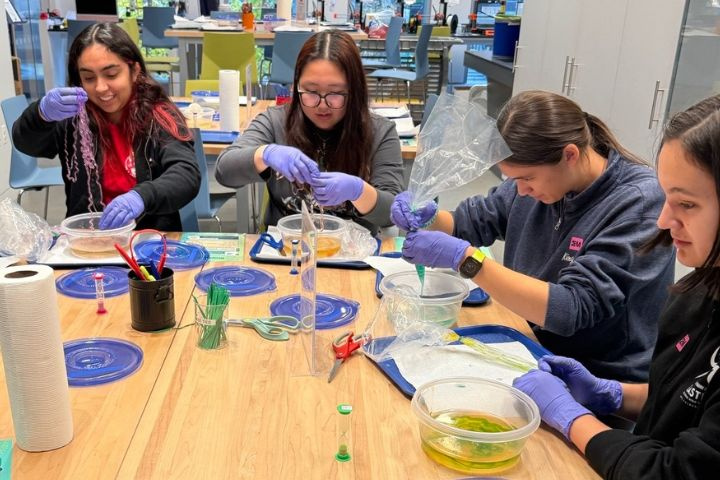
Students from 17.A90 experimented with bioplastics during a Halloween week visit to the MIT Museum.
Photo credit: Dr. Katherine Hoss
Politics, Policy, and Political Science: What does it all mean? This is the question posed by Professor Andrea Campbell and Dr. Katherine Hoss’s first year advising seminar (17.A90). Students interested in questions of political significance select the seminar over the summer before arriving at MIT; once on campus, they meet on a weekly basis to talk about all things politics and political science.
“The class is really interesting, because it brings together students whose political knowledge is varied in subject matter” says Hoss. “We’ve switched our focus this year so that students have a chance to discuss recent political events with faculty experts.”
The advising seminar puts students in the classroom with various political science faculty members to learn about a wide range of subjects including Chinese foreign policy, authoritarianism in Africa, U.S. nuclear strategy, and American elections and domestic policy. Alongside political science topics, the class seeks to welcome first year students to the MIT community and familiarize them with the resources available on campus. As part of that endeavor, the class went to the MIT Museum, where students toured the AI: Mind the Gap exhibit and got to experiment with making bioplastics.
“The first-years, who hail from many different states and countries, have asked the faculty really probing questions this year. The seminar also includes sessions on time management, internship opportunities, and interacting with faculty. We hope to see a lot of these students in future classes,” says Prof. Campbell.
Prof. David Singer, the Department Head and Raphael Dorman-Helen Starbuck Professor of Political Science, commended Prof. Campbell and Dr. Hoss for creating this seminar. “The first-year advising seminar is a splendid addition to our undergraduate curriculum, enabling students from a range of backgrounds to get an analytical taste for political science while committing only to a 3-unit class. We have already seen that many of these students continue their studies with us, attracted by our dynamic faculty and flexible program requirements.”